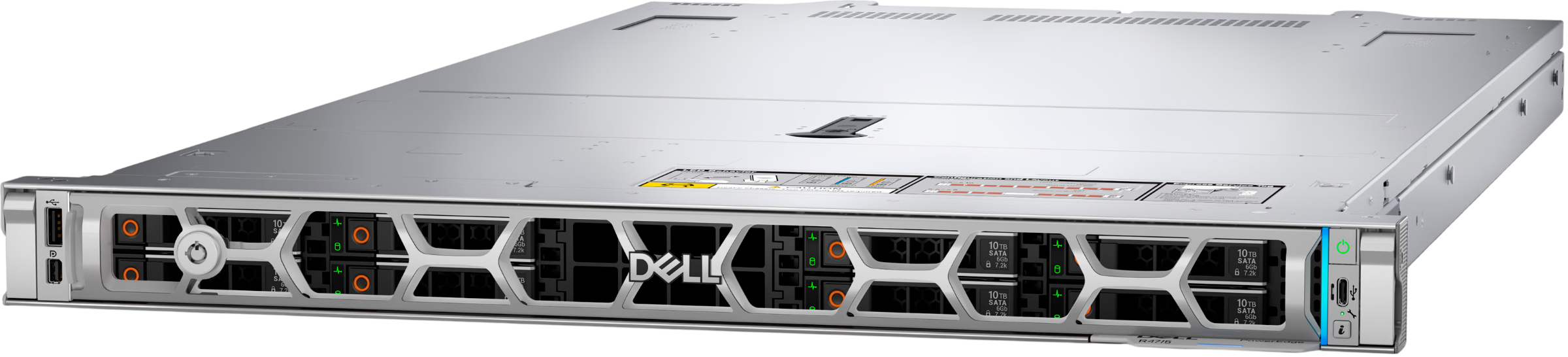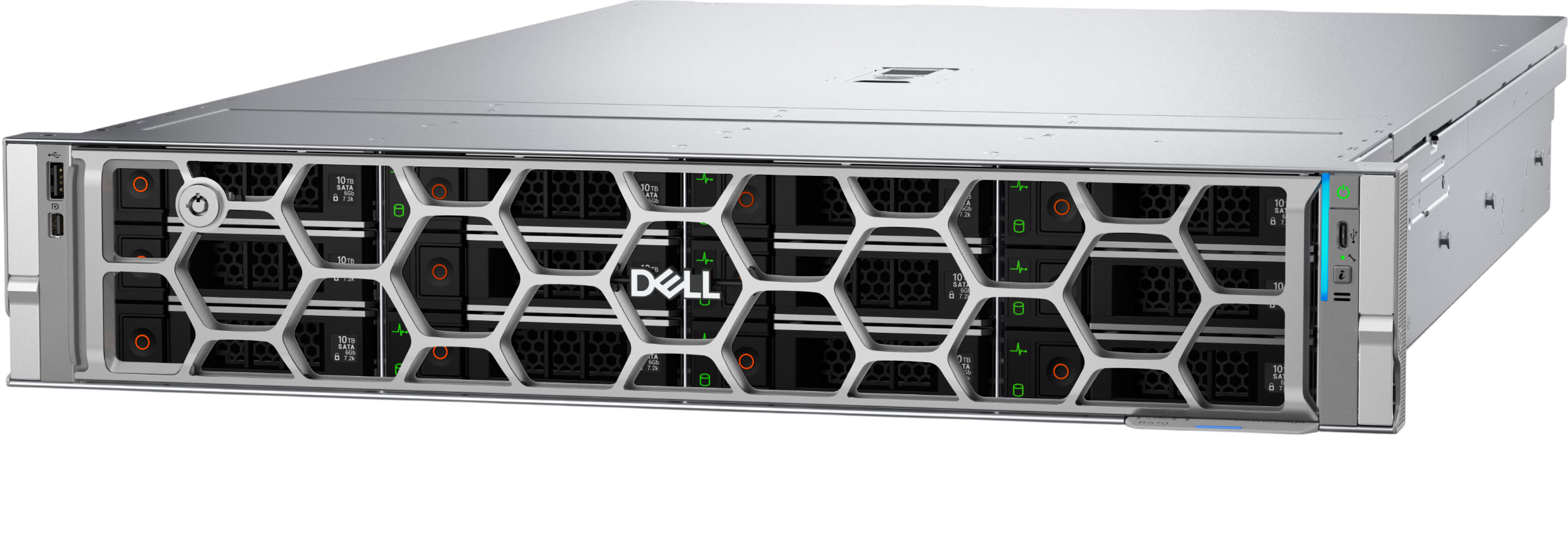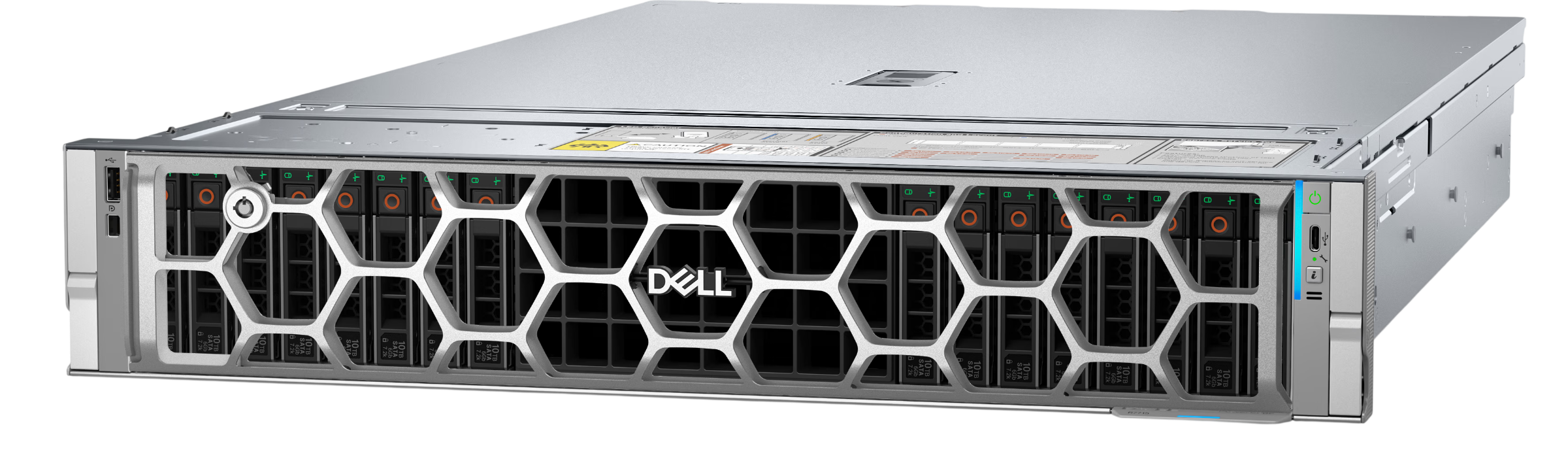
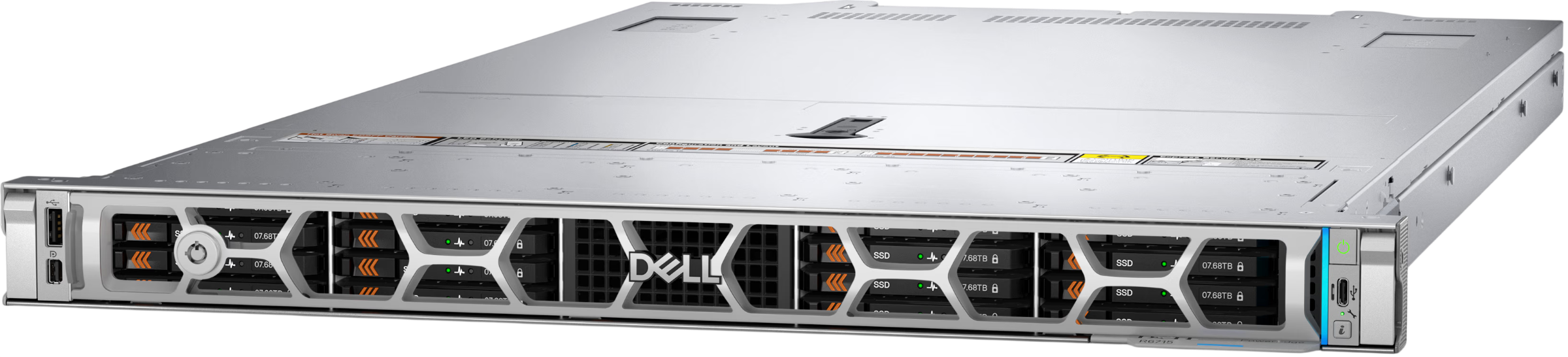
PowerEdge R6715 - 1 socket - Right-size memory and storage density
(DELL)
Workloads : Data Analytics, Dense Virtualisation, Software-Defined Storage
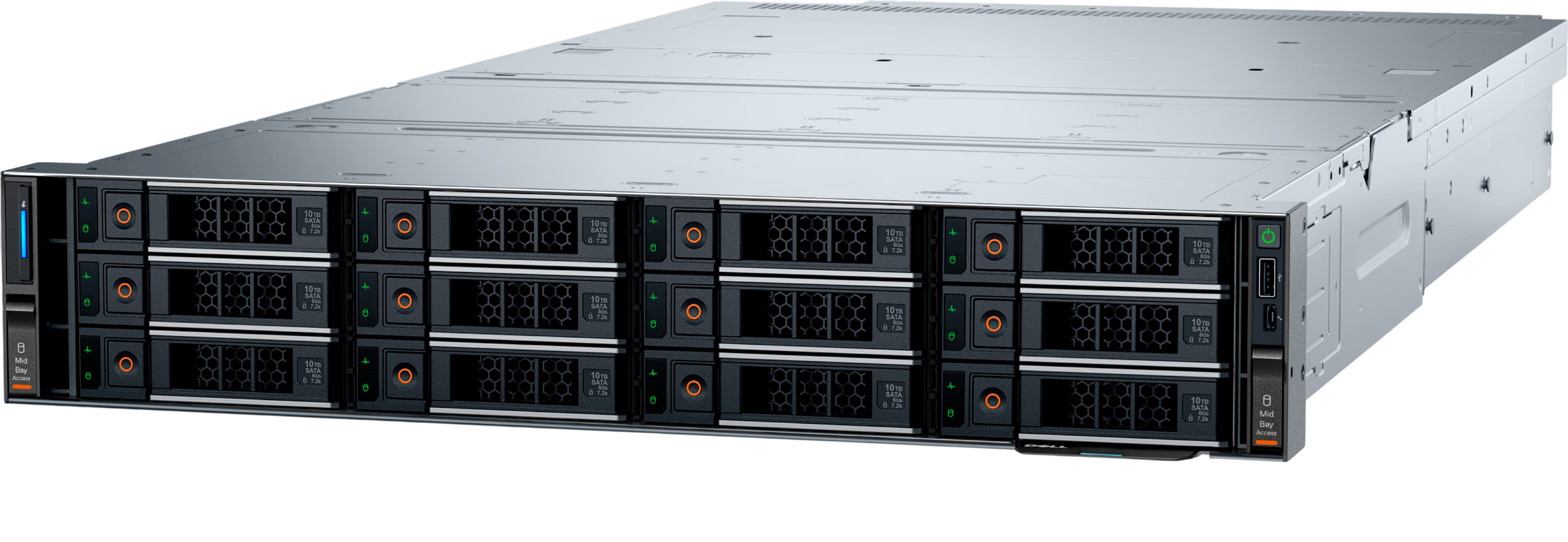
Form Factor : 1U Rack Server
Processor : 1 × AMD EPYC™ 9005 Processor
Maximum Memory : 24 × 256 GB DDR5 (Up to 6 TB)
Maximum Storage : Up to 1.2 PB
GPU : Up to 3 × 75W Single-Width (SW) GPUs
Processor
• One 5th Generation AMD EPYC™ 9005 Series Processor (Up to 160 Cores)
Operating System
• Canonical Ubuntu Server LTS
• Microsoft Windows Server with Hyper-V
• Red Hat Enterprise Linux
• VMware ESXi
• SUSE Linux Enterprise Server
Chipset
• AMD Chipset
Accelerators
• Up to 3 × 75W Single-Width (SW) GPUs
Memory
• DIMM Speed: Up to 5200 MT/s
• Memory Type: RDIMM
• 24 × DDR5 DIMM Slots
• Maximum Memory: Up to 6 TB RDIMM
Storage
• Front Bays
• Up to 4 × 3.5" SAS/SATA Drives
• Up to 8 × 2.5" Universal or U.2 / 10 × 2.5" SAS/SATA Drives
• Up to 10 × 2.5" Drives with 4 × Universal
• Up to 16 × EDSFF E3.S / 20 × EDSFF E3.S Drives
• Mid Bay
• N/A
• Rear Bay
• Rear 2 × EDSFF E3.S
Storage Controllers
• Internal: PERC H365i, H965i, H975i
• External: HBA465e
• Software RAID: N/A
• Internal Boot: Boot Optimized Storage Subsystem (BOSS-N1 DC-MHS)
Security
• AMD Secure Encrypted Virtualization (SEV)
• AMD Secure Memory Encryption (SME)
• Cryptographically Signed Firmware
• Data at Rest Encryption (SED)
• Secure Boot
• Secured Component Verification
• Secure Erase
• Silicon Root of Trust
• System Lockdown
• TPM 2.0 (FIPS, CC-TCG Certified)
• Chassis Intrusion Detection
Management
• iDRAC10
• iDRAC Direct
• iDRAC RESTful API with Redfish
• RACADM CLI
OpenManage Consoles
• OpenManage Enterprise (OME)
• OME Power Manager
• OME Services
• OME Update Manager
• OME APEX AIOps Observability
• OME Integration for VMware vCenter
• OME Integration for Microsoft System Center
• OpenManage Integration for Windows Admin Center
Tools
• IPMI
• Dell Repository Manager
• Dell System Update
• Enterprise Catalogs
• Server Update Utility (SUU)
OpenManage Integrations
• Red Hat Ansible Collections
• Terraform Providers
Power Supplies
• Platinum: 800W, 1100W
• Titanium: 800W, 1100W, 1500W, 1500W 277VAC & HVDC, 1800W
• Telco: 1400W -48VDC
Cooling
• Air Cooling
• Direct Liquid Cooling (DLC)
Ports
Front
• 1 × USB 2.0 Type-A (Optional LCP KVM)
• 1 × USB 2.0 Type-C (HOST/BMC Direct)
• 1 × Mini DisplayPort (Optional LCP KVM)
Rear
• 1 × 1Gb Dedicated BMC Ethernet Port
• 2 × USB 3.1 Type-A
• 1 × VGA
Internal
• 1 × USB 3.1 Type-A
Expansion Slots
• Up to 3 × PCIe Gen5 Slots (x16)
• Up to 2 × OCP NIC 3.0 (Optional)
• Supports 1GbE, 10GbE, 25GbE, 100GbE & 400GbE Networking
• PCIe Add-in NIC Support up to 400GbE & FC32
• 1 × Gen3 BOSS Slot
Video
• N/A
Bezel
• Optional Metal Bezel
Form Factor
• 1U Rack Server
Dimensions & Weight
• Height: 42.80 mm (1.68")
• Width: 482.00 mm (18.97")
• Depth: 816.92 mm (With Bezel) / 815.14 mm (Without Bezel)
• Maximum Weight: 21.19 kg (46.71 lbs.)
Rack Support
• ReadyRails II Sliding Rails with Optional CMA & SRB
• Combo (Drop-in/Slide-in) Rails
• ReadyRails Static Rails for 2-Post & 4-Post Racks
• CMA is not supported with Direct Liquid Cooling (DLC).
Adaptable and efficient mainstream servers
The Dell PowerEdge server is designed to enhance data centre efficiency with energy-efficient air cooling, reduced power consumption, and flexible scalability. It helps lower the total cost of ownership (TCO) while supporting evolving business and enterprise workloads.
Exceptional performance and efficiency
• Powered by one AMD EPYC™ 5th Generation Processor for high-performance enterprise computing.
• Supports up to 24 DDR5 RDIMM memory modules with a maximum capacity of 6 TB.
• Air-cooled architecture improves energy efficiency and reduces operational costs.
• Flexible and scalable design adapts easily to changing business requirements.
• Optimised for virtualisation, enterprise applications, software-defined storage, and data-intensive workloads.
Systems management and security solutions
OpenManage systems management
• Simplify IT operations with Dell OpenManage tools to discover, deploy, monitor, manage, update, and secure your PowerEdge infrastructure.
Intelligent automation
• Automate server lifecycle management using iDRAC, OpenManage Enterprise, and CloudIQ to improve efficiency and streamline IT operations.
Built-in security
• Protect your infrastructure with Dell's cyber-resilient architecture featuring Silicon Root of Trust, Secure Boot, signed firmware, component verification, BIOS recovery, and dynamic system lockdown for end-to-end security.